
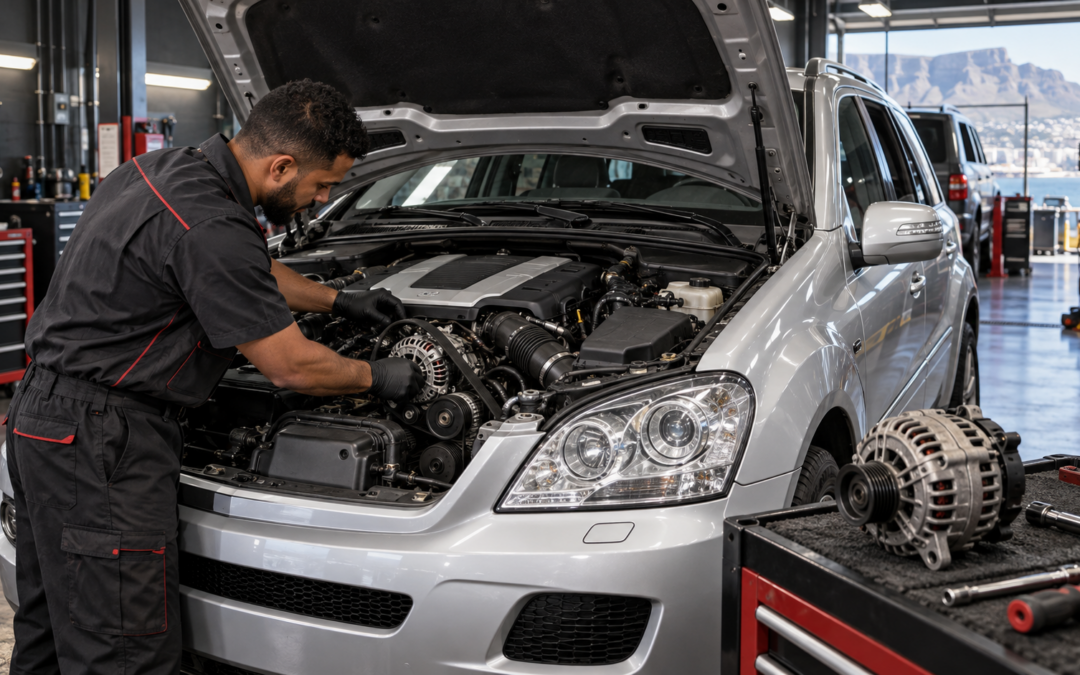
The Mercedes-Benz W164 ML320 CDI combines a 3.0-litre OM642 V6 diesel engine with a large number of electrical systems. Its alternator must support engine management, lighting, climate control, safety modules and battery charging under demanding conditions. A charging fault may create several warnings at once, so a structured diagnosis is better than replacing the battery repeatedly or assuming every dashboard message represents a separate failure.
Warning signs of an ML320 CDI charging fault
- A battery or charging warning appears in the instrument display.
- The vehicle reports multiple system faults after a low-voltage event.
- Starting becomes slow even after the battery has been charged.
- Lights dim, the blower changes speed or accessories reset.
- A burnt smell, hot cable or discoloured alternator terminal is found.
- The auxiliary belt squeals or the alternator pulley and bearings become noisy.
Why several warning messages may appear
Control modules need stable voltage to communicate. When system voltage drops, the vehicle may log communication, brake, steering, transmission or restraint-system faults even when those systems are mechanically sound. Record the codes, repair the charging fault and then reassess which warnings return. Replacing unrelated modules before stabilising voltage can become very expensive.
Test the battery and cables first
The W164 requires a battery of the correct specification and condition. Inspect terminals, main cables and earth connections for looseness, corrosion and heat damage. A battery can show reasonable voltage with no load yet collapse during cranking. A proper conductance or load test helps establish whether it can accept and hold charge.
Voltage-drop testing is especially useful on a high-current diesel starting and charging circuit. Resistance in the positive cable or earth path can reduce charging at the battery while the alternator itself produces power. Check the relevant fuses and distribution points according to vehicle-specific information.
Inspect the auxiliary belt system
The alternator is driven by the serpentine belt. Check the belt for cracks, glazing, contamination and missing ribs. Inspect the tensioner, idlers and alternator pulley for noise, wobble or seizure. An oil or coolant leak onto the belt can shorten its life and cause slipping. If a pulley locks, a new alternator or belt may be damaged soon after installation.
Because access around the OM642 can be restricted, a workshop should identify the true source of a front-engine noise before dismantling. Sound travels through brackets and can make one component appear responsible for another.
Charging tests that give useful answers
Measure battery state before starting, cranking performance and charging voltage once the engine runs. Repeat the test with lights, climate blower, heated windows and other available loads switched on. The expected charging strategy can vary with operating conditions, so interpret the readings with suitable service information and diagnostic data rather than relying on one universal number.
Look for excessive AC ripple, unstable output and voltage loss between the alternator and battery. Never remove a battery lead while the engine runs. On a vehicle with sensitive electronics, that can create a damaging voltage spike.
How to match the correct OM642 alternator
Use the VIN and the original alternator number. Compare the output rating, pulley type, mounting ears, electrical plug and main terminal position. The OM642 engine was used in several vehicles and power outputs, but that does not mean every alternator is interchangeable. Brackets, regulators, connectors and communication features can differ.
The Cape Town Auto Spares catalogue includes a Mercedes-Benz W164 ML320 CDI alternator from an identified 3.0-litre V6 diesel donor. Send the label and connector photographs from your original unit before ordering.
What to check on a used alternator
The casing and mounts must be intact. The pulley should turn smoothly without roughness or obvious shaft play. Inspect the plug and output terminal for burning, corrosion or damaged threads. Ask what testing was completed and whether the pulley is included. A genuine used assembly can be a practical choice when fitment is confirmed and the charging system’s underlying fault has been corrected.
Replacement planning
Disconnect the battery correctly and preserve any vehicle settings required by the repair procedure. Record the belt route and inspect tensioner components while the belt is removed. Cables must be secured away from hot surfaces and moving parts. After installation, charge and test the battery, verify output under load and scan the vehicle again.
Professional installation is recommended because access, belt routing and electronic diagnosis are more involved than on a basic petrol vehicle. If the old alternator failed because of an oil leak, wiring fault or seized pulley, repair that cause before fitting the replacement.
Protecting the replacement alternator
Do not place a new or used alternator into a system with an untested, deeply discharged battery. Charge and test the battery independently first. Verify that cable terminals are clean and tight, that the belt tensioner operates smoothly and that every pulley aligns correctly. Repair oil or coolant contamination before the vehicle returns to service.
High-current accessories should be wired and fused by a competent installer. Poor aftermarket connections can overload circuits or create drains that are mistakenly blamed on the alternator. Following the repair, keep a record of the battery test, charging readings, alternator number and any diagnostic codes. If symptoms return, those details give the next technician a reliable starting point instead of repeating the same parts.
Periodic inspection of the belt drive is particularly worthwhile before long-distance towing or holiday travel, when electrical and cooling loads are likely to be high.
Frequently asked questions
Can low voltage trigger gearbox or ABS warnings?
Yes. Low voltage can disrupt several modules. Repair the supply fault, clear codes and see which faults return.
Is a new battery enough?
Not if the alternator, belt or wiring is faulty. The replacement battery will also discharge.
Will any OM642 alternator fit?
No. Match the VIN, original number, rating, pulley, mounts and electrical connections.
Need a Mercedes ML320 CDI alternator?
Send the VIN and clear photos of the label, pulley and connector to Cape Town Auto Spares. We supply Cape Town customers and courier parts throughout South Africa.