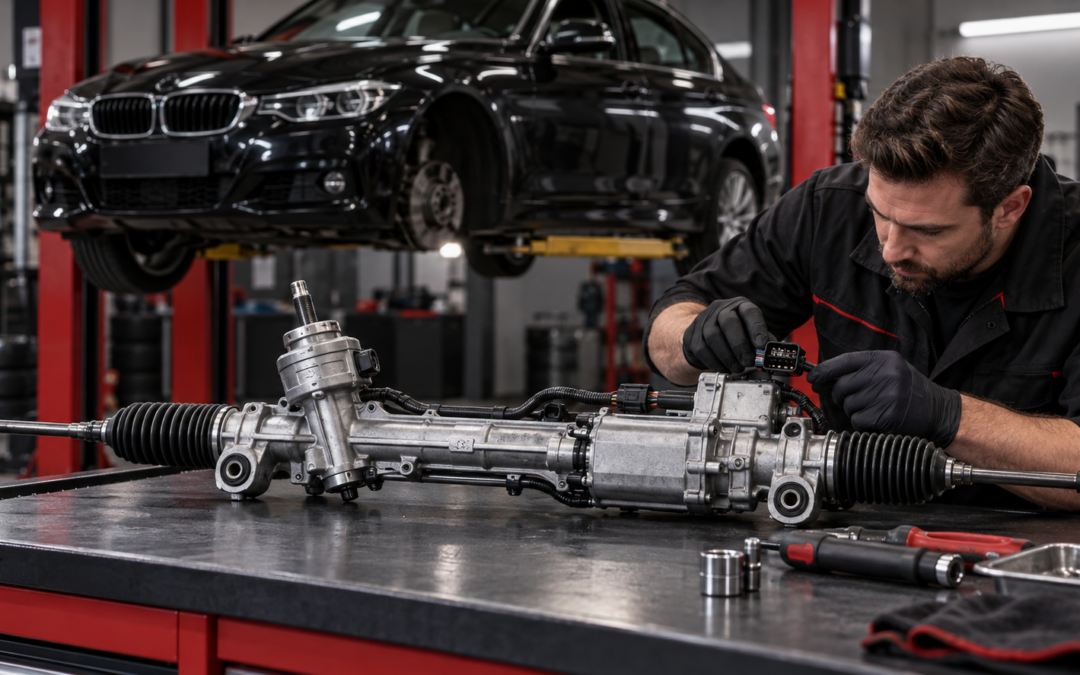
The BMW F30 316i uses an electrically assisted steering system that combines mechanical steering components, an electric motor, sensors and control electronics. Heavy steering or a dashboard warning does not automatically prove that the complete rack has failed. Battery voltage, wheel alignment, suspension damage, wiring and software can all affect the system. Accurate diagnosis is especially important because the correct replacement rack must match the vehicle and may require calibration after installation.
Common steering-rack symptoms
- Steering assistance warning: The wheel may become noticeably heavier when electric assistance is reduced or disabled.
- Knocking over rough roads: Play can come from inner tie rods, rack components, column joints or suspension parts.
- Uneven or notchy assistance: Binding, sensor faults or motor-control problems may make steering effort inconsistent.
- Steering does not self-centre normally: Check alignment, tyre condition, strut mounts and mechanical binding as well as the rack.
- Vehicle pulls or steering wheel sits off-centre: Alignment or accident damage is more common than an electronic rack fault.
- Water or impact damage: Damaged undertrays, connectors or rack housings need immediate inspection.
Start with the basics
Inspect tyre pressures, tyre wear and wheel condition. Different pressures or a damaged tyre can create a strong pull. Check front suspension joints, control-arm bushes, strut mounts and wheel bearings. Inner and outer tie-rod wear can produce free play that feels like a rack problem.
Battery condition is important on an electrically assisted system. Low voltage during starting or charging faults can trigger steering warnings. Test the battery and alternator, then inspect relevant fuses, connectors and earth points. A diagnostic scan using equipment that can communicate with the steering system should be carried out before parts are ordered. Record fault codes and live data rather than clearing them immediately.
Mechanical checks on a lift
With the vehicle safely raised, a technician can check for movement in tie rods and rack mounts while an assistant moves the steering gently. Look for damaged boots, contamination and impact marks. The steering should move smoothly without tight spots. Never work under a vehicle supported only by a jack.
If the car has been involved in a collision or hit a large pothole, measure wheel alignment and inspect the subframe. A bent component can overload the rack or prevent correct centring. Replacing the rack without correcting the chassis or suspension problem can damage the replacement.
Matching the correct F30 steering rack
Use the full VIN and the number on the original rack. Confirm that the donor unit is for a right-hand-drive application, because left- and right-hand-drive racks are not interchangeable. Compare mounting points, input-shaft spline, tie-rod arrangement, electrical connectors, motor position and control-unit details.
BMW production changes and equipment options can affect compatibility even within the F30 generation. The fact that two cars are both labelled 316i does not guarantee that their rack numbers or software requirements are identical. The N13 engine description helps identify the donor vehicle but does not replace a VIN-based steering-part check.
See the 2014 BMW F30 316i steering rack in our used-spares catalogue and contact us with the number from your existing unit.
Inspecting a genuine used rack
Check the housing for cracks, heavy corrosion and impact damage. Inspect rubber boots and connectors, confirm that mounting points are undamaged and look for play at the inner tie rods. Ask whether the rack came from a running donor and what testing has been done. Clarify whether tie rods, motor and control electronics are included, because listings can differ.
A used rack should not be judged only by how clean it looks. Correct identification and the condition of its mechanical and electronic components are more important than cosmetic marks.
Installation, alignment and calibration
Steering is safety-critical, so professional installation is strongly recommended. The battery must be disconnected using the correct procedure, the steering wheel should be secured in the straight-ahead position and the column must not be rotated carelessly while disconnected. All fasteners and single-use hardware should be handled according to workshop information.
After installation, the front wheels require alignment. Depending on the exact system and repair, steering-angle, end-stop or rack-centre calibration may be required with suitable diagnostic equipment. Fault codes should be rechecked after a controlled road test. A mechanically correct installation can still show a warning if calibration is incomplete.
When rack replacement is justified
A complete replacement becomes reasonable when testing confirms internal mechanical play, binding, impact damage, water ingress or an electronic fault integral to the rack assembly. It should not be the first response to an unexplained warning light. Ask the technician for the fault codes, mechanical findings and alignment measurements so the decision is supported by evidence.
If the original rack was damaged by a collision or pothole impact, inspect the wheels, tyres, control arms, knuckles, subframe and steering column before fitting another unit. If water entered through a damaged boot or connector, repair the source and verify that the loom is clean and dry. Correcting these related problems is essential to protecting the replacement rack.
Ask for a printed alignment report after the work. It provides evidence that toe and steering-wheel position were checked, helps expose bent components and creates a useful baseline if tyre wear or pulling develops later. Recheck fasteners and boots during the next scheduled service.
Frequently asked questions
Can a weak battery cause a steering warning?
Yes. Low voltage can interrupt electric steering assistance or store fault codes, so the battery and charging system should be tested first.
Does a knock always mean the rack is worn?
No. Tie rods, control-arm bushes, strut mounts, column joints and subframe movement can all knock.
Can I fit the rack without programming?
Requirements vary by part number and vehicle. Plan for diagnostic checks, calibration and alignment rather than assuming it is a simple bolt-on job.
Looking for a BMW F30 steering rack?
Send Cape Town Auto Spares your VIN, rack number and connector photographs. We will confirm the donor details and current availability before nationwide dispatch.